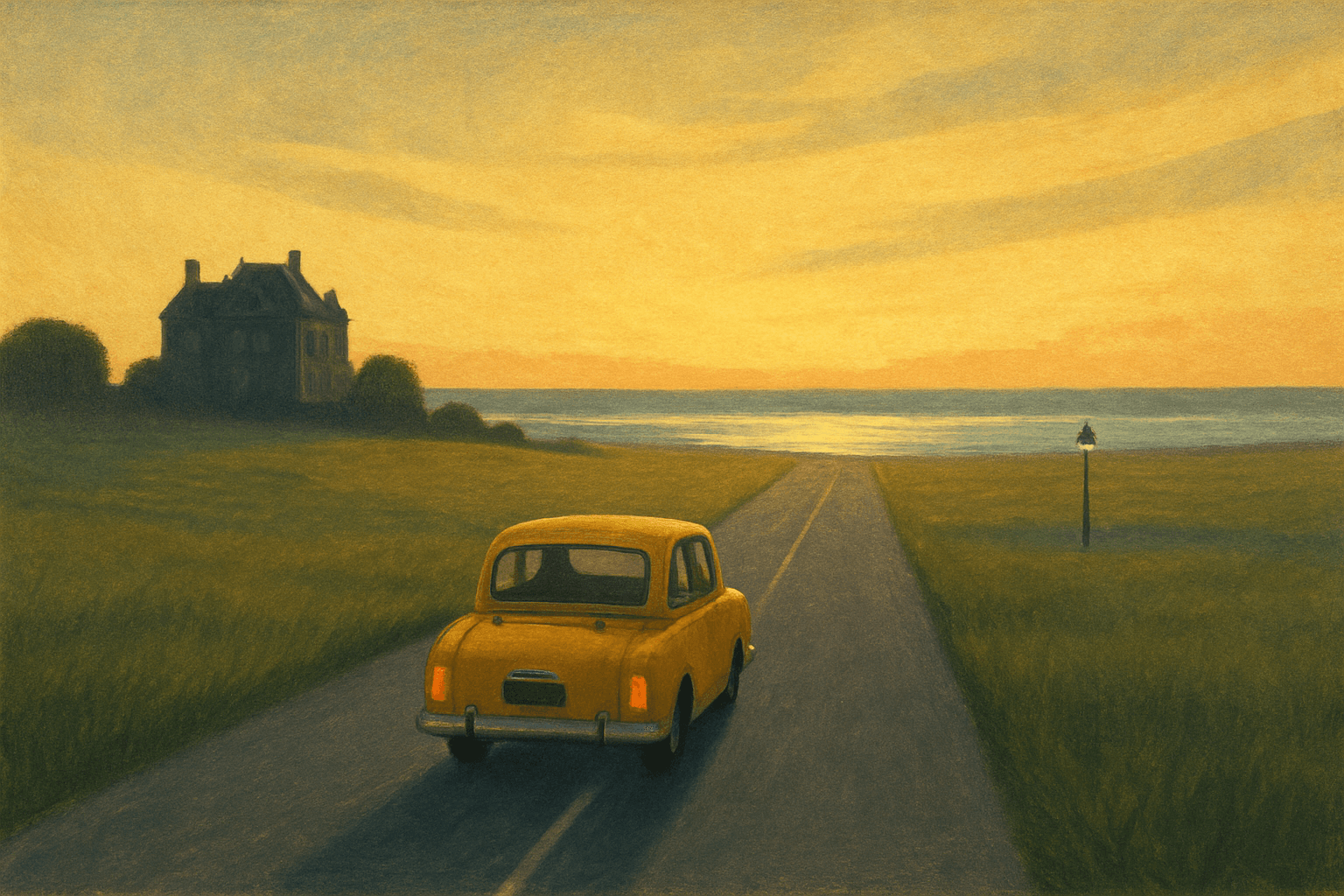
I could not sleep that night. There was a fog off the Sound and a foghorn groaning endlessly, and toward morning I heard a taxi go up Gatsby's drive and immediately I jumped out of bed and began to dress. I felt that I had something to tell him, something to warn him about, and morning would be too late.
I cut across the lawn while the sky was still that colorless gray of the hour before dawn. The great house loomed unlit, its enormous incoherent failure of a house, and I found the side gate open and the garden wet with dew that had not yet caught the sun.
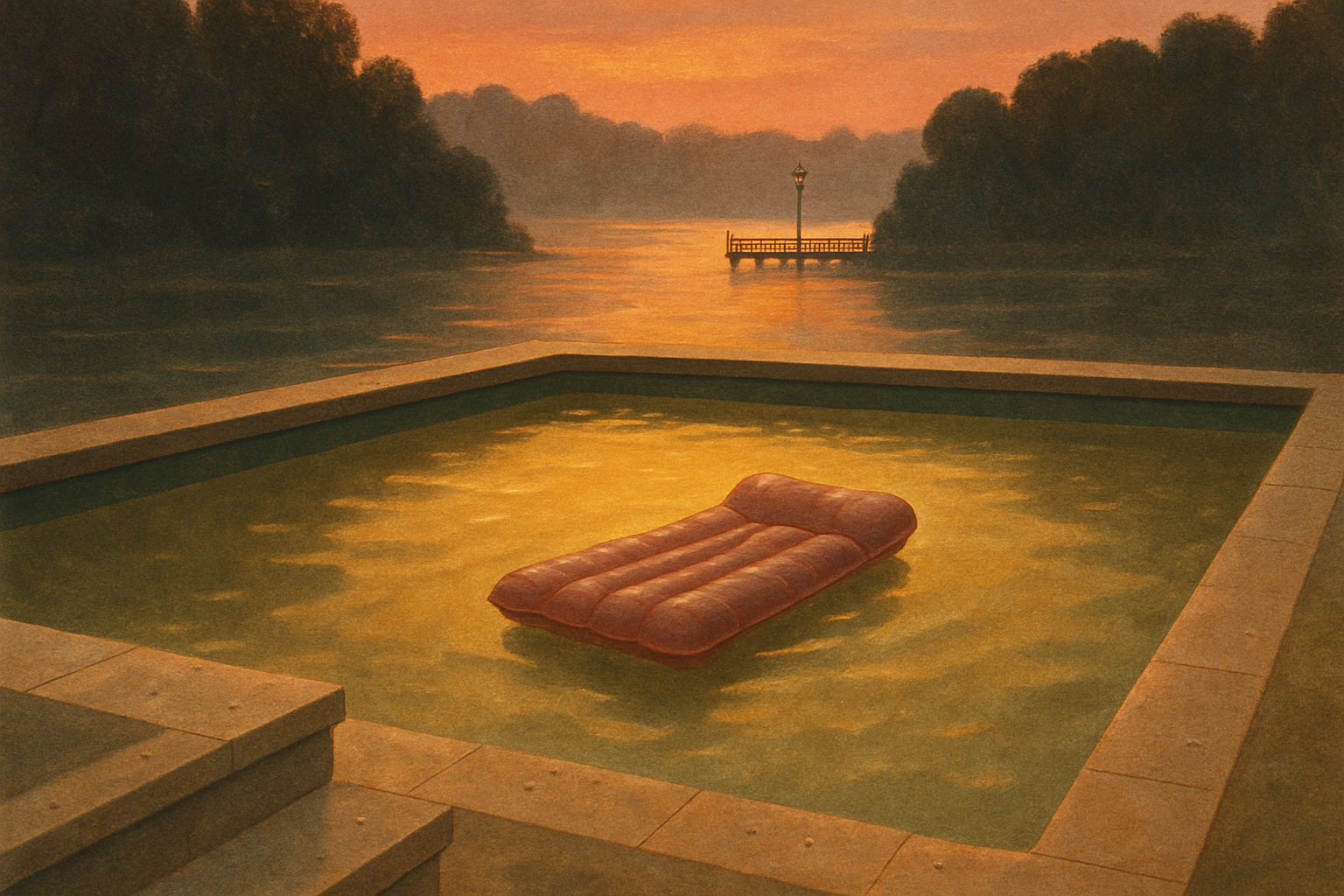
Gatsby was at the pool. He had drawn one of the pneumatic mattresses onto the water and lay upon it in his bathing suit, one hand trailing, watching the far end of the garden where the trees came down to the wall. He had told Wilson nothing, of course. He would tell no one. He would take Daisy's crime and wear it like a decoration.
"Old sport," he said without turning. "You couldn't sleep either."
"She isn't going to call," I said. I had not meant to say it so plainly. But I had come to say it, and there it was.
He was quiet a long time. The water lapped against the mattress with a small, patient sound.
"There's the phone," he said. "There's still the whole day. Tom will go to the city and she'll be alone in that house and she'll pick up the phone and I'll be here."
And then I saw the man.
He came out of the shadow of the trees the way a thing comes out of water, gray and slow and terrible, and there was something in his hand that caught what little light there was. Wilson. His clothes were ruined, his face was the face of a man who had already died and simply had not fallen down yet.
I did not decide to shout. The sound came out of me before I knew it. "Jay! Get down!"
Gatsby rolled from the mattress into the pool the instant the pistol spoke. The report cracked flat across the water and the mattress heaved and turned, and a hole opened in the rubber and it began, slowly, to breathe out its air. Gatsby came up gasping at the ladder, and the second shot went wide and struck the tiles and whined off into the garden, and by then I was running at Wilson across the wet grass, absurd and unarmed, my arms out as if to catch him.
But Wilson was not aiming at me. He had stopped. He stood swaying, looking at the man in the water who had come up alive, and I think the sight of that, of Gatsby living, of a plan gone wrong in the one way he could not survive, undid whatever thin thread had held him together through the night. He sat down in the grass very carefully, the way a tired man sits, and he put the pistol against himself, and I was still three strides away when the last shot came.
Afterward there was a long time in which nothing moved except the deflating mattress, turning and turning at the far end of the pool.
Gatsby climbed out. Water ran off him and pooled at his feet. He looked at Wilson in the grass and then at me, and for once there was nothing performed in his face, no gorgeous certainty, no smile that understood you and believed in you just as you would like to be believed in. There was only a man, middle sized, wet, blinking in the coming light.
"He thought it was me," Gatsby said slowly. "Driving. He thought it was me."
"Yes," I said. There was no reason to spare him that now.
He sat down heavily on the marble steps. The sun broke the ridge of trees at last and the pool went suddenly gold, and somewhere in the house, faint and ridiculous, the telephone began to ring.
He lifted his head. Every muscle of him leaned toward that sound. It rang, and rang, and I watched him gather himself to rise, to run, to take the stairs three at a time and seize the receiver and hear her voice tell him she was coming, that she had chosen him, that the four years and the mansion and the shirts and the parties had all bought what they were meant to buy.
He did not move.
We listened to it ring. Eight times, perhaps nine. Then it stopped, and the silence after was enormous.
"You could still answer it," I said.
"No," Gatsby said. He was looking at the water. "I know what she'd say, old sport. She'd say she couldn't get away just now. She'd say tomorrow. There was always going to be a tomorrow with Daisy." He said her name and it did not shine the way it always had when he said it. It was just a name, two syllables, a girl in a house across the water. "A man ought to be able to repeat the past," he said. "I told you that. I believed it like I believed in God."
"And now?"
He smiled then, but it was a new smile, a poor and human one. "Now I think the green light was only a light," he said. "It was on somebody's dock the whole time. It didn't mean anything. I made it mean everything."
We buried the noise of the morning between us. I thought of all the arrivals I had watched at that pool, the whole rotten crowd of them, and how not one would come today, and how none of it had ever been for them anyway.
The police came, and the reporters, and the enormous machinery of a scandal that Tom and Daisy would slip out from under as they slipped out from under everything, retreating back into their money and their vast carelessness and letting other people clean up the mess they had made. But Gatsby did not offer them anyone to blame. He stood in his own drive in a dry suit and told the truth about none of it and lies about none of it, and something in him had gone very quiet and would stay quiet.
He sold the house before the leaves turned. I helped him close it up, the two of us walking through those cathedral rooms where the laughter had died, our footsteps echoing.
"West," he said, at the door, with his hat in his hands. "There's a town in Minnesota where nobody ever heard of Jay Gatsby. Maybe there never was one to hear of." He looked back once at the Sound, and Daisy's dock was there across the water, small and white, and if there was a light on it he did not search for it. "Come out sometime, old sport. I'd like that. I find I'd rather have one friend than a thousand guests."
He went, and I stayed on a while in the East before I too went home. But I have thought since that he was luckier than he knew, standing wet in that garden with the phone ringing, because he was given the rarest thing a dreamer is ever given. He was allowed to live, and to learn that the light goes out, and to go on anyway, borne back not into the past at last, but simply forward, into an ordinary and unbearable and merciful morning.