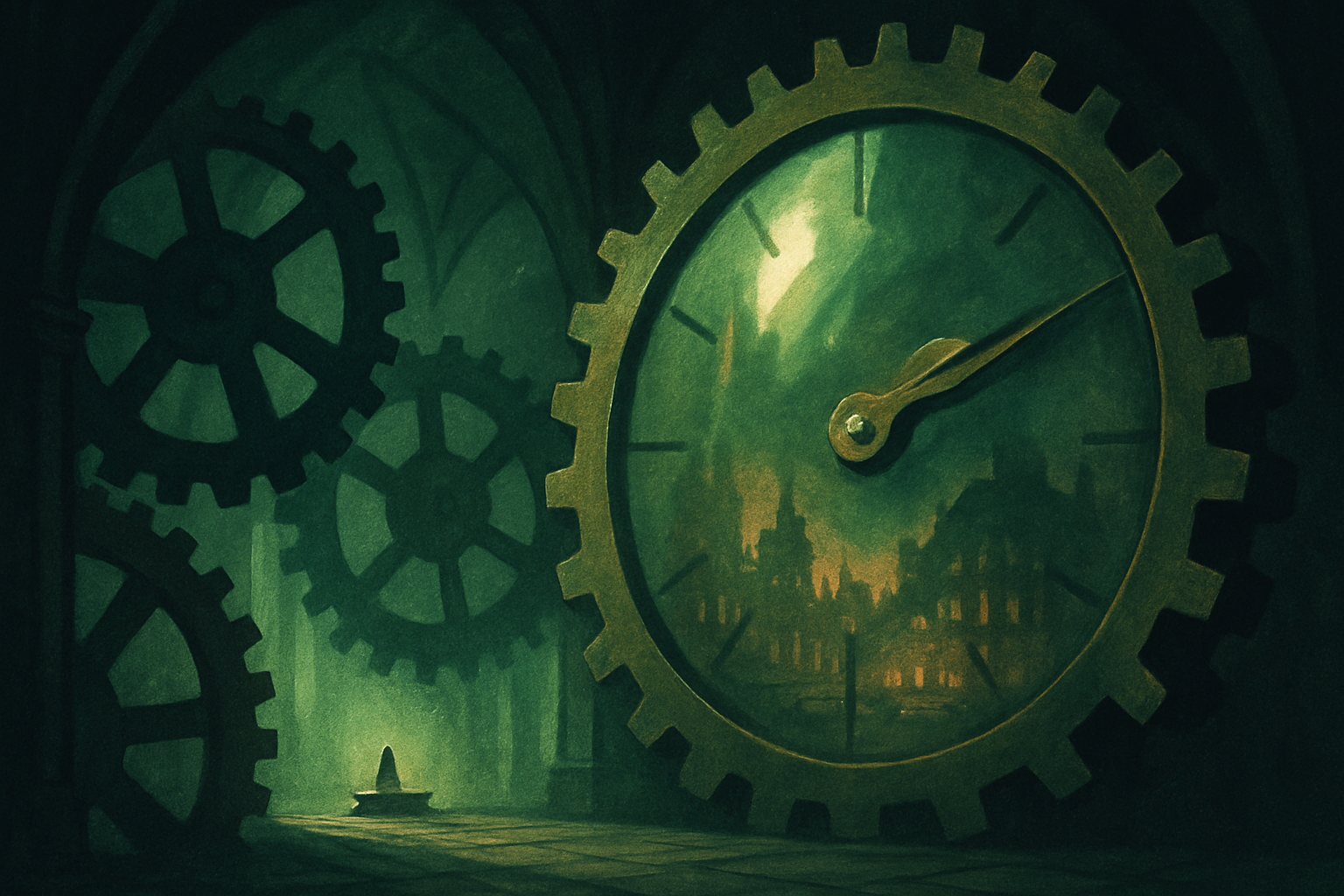
The throne room was not a throne room anymore. It was the inside of a clock.
Doom had built it beneath the ruins of what had once been a city, and every wall turned with the slow gravity of gears the size of cathedrals. Green light bled from the seams. Somewhere, a bell that had not yet been forged was already tolling backward.
They stood in a loose crescent before the dais: what remained of them. Not many. The war had been thorough.
"You came," Doom said. His voice did not echo. The room swallowed echoes the way it swallowed time. "I confess a small surprise. I had prepared a speech for an empty hall."
"We came to end this," said the woman at the center, her jaw set, her hands open at her sides where the weapons should have been. There were no weapons left. That was the point of coming empty. "Whatever this is."
"This," Doom said, spreading gauntleted fingers, "is mercy. Though you will not recognize it. Mercy rarely wears the face you expect."
Behind him, the great gear turned, and in its polished face they saw reflections that did not match the room. A boy who had died on a bridge, walking. A city that had burned, standing. A soldier who had fallen out of the sky, laughing at something no one could hear.
"I have solved it," Doom said simply. "The equation you could never balance. Every loss. Every grave you dug with your beautiful, useless hands." He stepped down from the dais, and the gears leaned toward him like flowers to a sun. "I can turn it back. All of it. Not a fraction. Not a bargain with a monkey's paw that costs you a finger for a wish. The whole of it. Every death since the day the sky first cracked open, unmade."
No one spoke. The bell tolled backward again, closer.
"You lie," said the archer, though his voice broke on it, because he wanted it to be a lie and knew, somehow, that it was not.
"I have never needed to lie to you," Doom said. "That was always your gods and your soldiers and your merchants of hope. I offer only arithmetic. I have the throne now. I have the stones' shadow, the sum of what they were. I can spend it once. And I choose to spend it on the thing you could not do."
He let that land.
"Bring them back."
The woman at the center felt the words go through her like a blade drawn slowly. She thought of a name she had not said aloud in a year because saying it split her open. She thought of a small hand she had failed to catch.
"What's the cost," she said. Not a question. A refusal to be seduced.
"Clever," Doom murmured. "Always the cost. Very well." He turned, and the gears turned with him, and the room became a mouth about to speak a terrible truth. "The cost is me. When time folds back, it folds around the hand that folds it. I remain. I remember. All of you return to the morning before the first grave, innocent as milk, and I alone will carry the knowledge of what was. Your enemy, immortal at the center of a world that no longer needs saving, because I will already have unmade every wound before it bleeds."
"You'd rule," the archer said.
"I would tend," Doom corrected, and for the first time something ancient and tired moved under the iron of his voice. "There is a difference, though you have never let me demonstrate it. A garden does not resent the gardener. It resents only the storm. I will be the reason the storm never comes. And you will hate me for a peace you cannot remember needing."
The woman's mouth was dry. "And if we say no."
"Then they stay dead," Doom said, gentle as a closing door, "and you have chosen your pride over their breath. I will let you leave. I will even let you try to kill me, though we both know how that ends. But you will walk out of this room having decided, with your own mouths, that a child stays in the ground rather than owe her life to Victor von Doom." He spread his hands. "I have made it a vote. That is my cruelty. I have made it yours."
The silence after that was the loudest thing in the world.
The archer was crying without moving his face. The soldier beside him had his eyes shut, and everyone knew whose name was behind them. Everyone in the crescent was doing the same terrible sum, the arithmetic of the dead, weighing every future against every ghost.
And the woman at the center understood, at last, the true shape of the trap.
It was not the deal. The deal was almost honest. That was the horror of it.
"You want us to say yes," she said slowly.
"I want you saved."
"No." She took a step forward, onto the first gear, and it did not turn beneath her. "You want us to choose it. Freely. Because a world you conquer is a world that spends forever trying to unseat you. But a world that begged you to save it, that stood in your clock and voted with tears on their faces for you to become its immortal keeper, that world is yours by consent. Forever. You don't want the throne. You want the invitation."
Doom was very still.
"You've done the math," she said, and her voice climbed, steadied, became the thing the others could stand behind. "But you left out a number. You always do. You leave out the one variable you can't control." She looked back at them, at the wet-eyed remnant of everything she loved. "What it does to a person to be loved out of gratitude instead of choice. You'd bring them back, and they'd live, and somewhere in them would be a splinter that says: I owe him. My whole life is a debt to the man who made me. That's not resurrection. That's ownership with a heartbeat."
"They would be alive," Doom said, and now there was heat in it, the first crack. "You would trade their life for a splinter?"
"I would trade my grief for their freedom," she said. "Every day. That's the only real math there is." She turned to the crescent. "I'm not voting for all of you. He wants a vote. Fine. But I vote no, and I vote it loud, and I vote it so that if there is any version of them still listening across every folded second, they hear that we loved them enough to leave them free."
The archer wiped his face with the back of his hand. He looked at the reflection in the gear, the boy on the bridge, walking. He looked away.
"No," he said.
The soldier opened his eyes. "No."
One by one, down the crescent, the word went. Not a shout. A vow. No. No. No. Each one a grave they chose to keep, a hand they chose not to be given back on a monster's terms.
Doom stood at the center of his clock while the gears, sensing no consent, began to slow. The green light guttered. The backward bell fell silent, its sound folding into the unmade future it would never ring.
"You would damn them," he whispered.
"We would honor them," the woman said. "You never learned the difference. That's why you keep losing to us with all the power in the world."
And the clock, denied its invitation, began to stop.