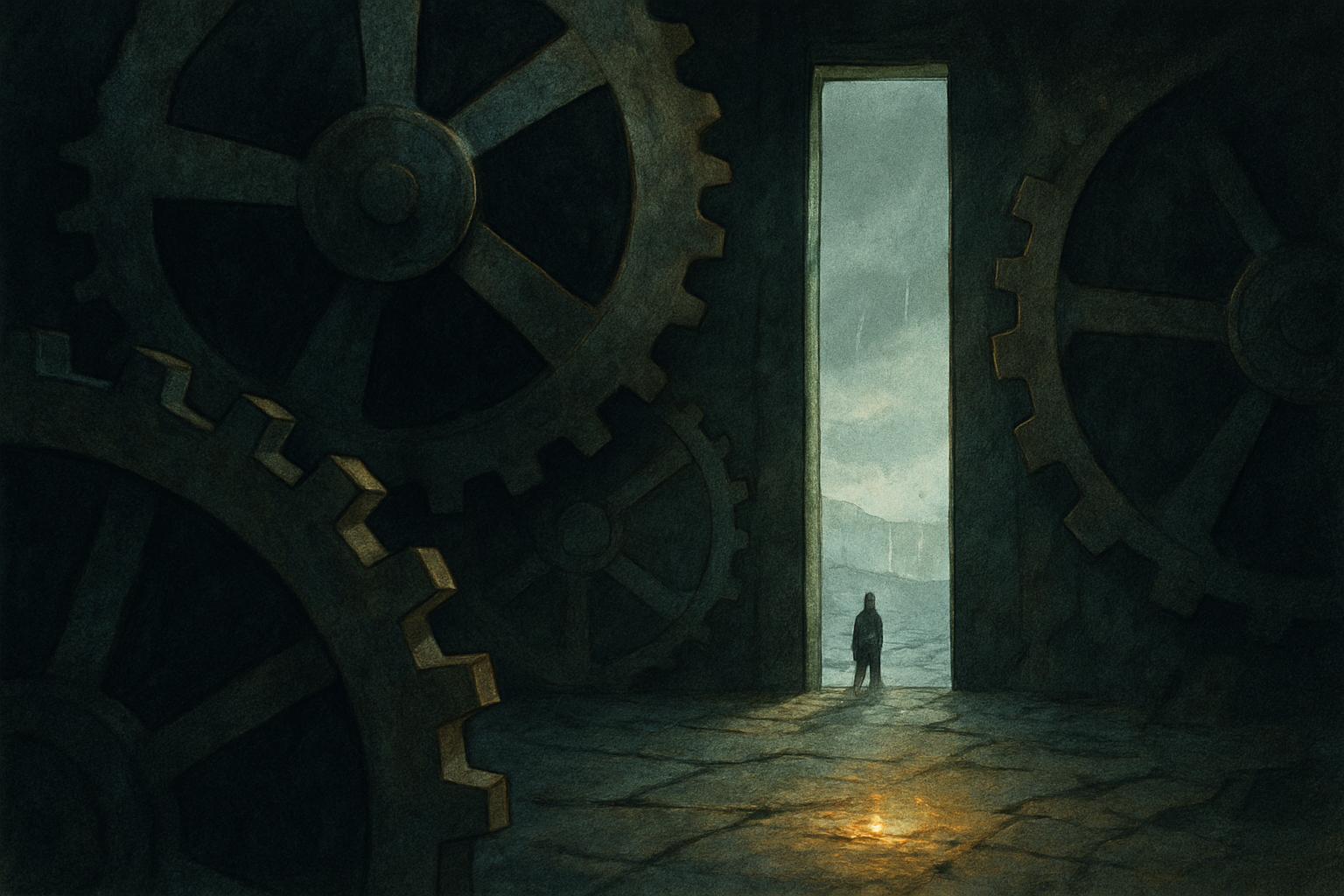
The doorway of gray dawn was colder than the clock had been.
The woman crossed it first, and the world on the other side did not thank her. That was the thing no one warned you about after a war you won by refusing something: there was no chorus, no swelling light. There was only a cracked plaza under a sky the color of ash on its way to blue, and the smell of rain that had not yet decided to fall, and the small, unbearable ordinariness of continuing.
She stopped and breathed it in like a woman surfacing.
The others came through behind her, one by one, and stood blinking in the raw morning. The archer put his hands on his knees and stayed that way a while, not crying, not laughing, just letting his body remember that it was allowed to be tired. The soldier turned once to look back at the seam of green, watched it narrow, and did not raise a weapon to widen it.
"That's it?" the archer said finally, straightening. "We just, what, go home?"
"We go home," the woman said.
"He let us."
"He let us," she agreed, and did not pretend that sat easy in her.
Because it didn't. She had walked into the clock expecting to die, and dying had a shape you could hold. This had no shape. This was the specific horror of a held breath released and finding the room still full of the thing you'd feared. Doom was not dead. Doom was standing in a cooling machine somewhere behind the light, and Doom did not lose, and men who did not lose did not simply stop.
She was still turning that over when the seam of green did not close.
It should have. It had been thinning, a wound sealing. Instead it steadied, and held, and out of it, unhurried, came the sound of measured footsteps on ground that had never known a footstep before, and then the man himself, crossing his own broken threshold into a dawn that was not his.
The archer's hand went to a bow that wasn't there. The soldier stepped in front of the woman, and it was reflex, it was love in the shape of a body between hers and harm, and she put her hand flat on his shoulder and moved him, gently, aside.
Doom stood in the ashen light. He looked smaller out here, the way anything looks smaller once you stop letting it be the sky. The mask caught the dawn and threw none of it back.
"You said we could go," the woman said.
"You may." He did not come closer. "I have not come to keep you. I have come because a proof does not end when the one who wrote it walks out of the room. It follows him. It has followed me across the threshold." A pause, and his voice, when it came again, had the strangest quality she had ever heard in it. Not command. Inquiry. "I would ask you a thing, and I do not know the answer, and I have never in my existence said those words in that order."
The woman waited.
"You refused the world. I understood that. Martyrs refuse worlds; it is the cheapest heroism, to die for an abstraction, as you yourself named it." His head tilted. "Then you refused the one hand. And that I did not understand, and I have turned it in my mind while the last gear cooled, and I find I am unable to file it away. So I will ask, plainly, as a student and not a king. When you drew your hand back from the child's, in that last moment, before the reasons, before the speech you made about thrones and habit, before any of your architecture of principle, in the half-second when it was only your arm and her face, what stopped you? Not why. What."
And the woman understood that this was the real reason he had followed them out. Not to punish. Not to bargain. He had built a machine to hold every version of every soul across the folded sky, and there was one motion inside one woman he could not model, and it was killing him, quietly, the way an unsolved thing kills a mind that has never before met its limit.
She thought about lying. It would have been a small cruelty and he had earned worse.
"Love," she said.
"You said love was the choosing. The eyes open. The refusal."
"That's what love does. It isn't what love is." She searched for it, honestly, because he had asked honestly, and something in her would not dishonor an honest question even from him. "What stopped my hand wasn't a principle. Principles are what I built afterward to keep myself standing. What stopped my hand was that I already loved her. Past tense that never ends. And you can't add to a whole number. She was already completely loved. Taking her back wouldn't have loved her more. It would only have loved me more, comforted me, spared me. My hand stopped because for one half-second I saw the difference between loving her and needing her, and they had been the same thing my whole life, and there in your gold light they came apart, and I saw that the loving was already finished and perfect and mine, and the needing was the only part you could sell me." She swallowed. "You can't buy back what someone already gave completely. There was nothing left to purchase. That's what stopped my hand. It reached, and then it understood there was nothing there to take, because I already had all of her I was ever going to get, and it was enough. Not enough to stop hurting. Enough to stop reaching."
Doom was silent for a long time.
The rain made its decision and began, fine and cold, ticking on the broken stones like a smaller, kinder clock.
"Enough," he repeated, and the word came out of him wrong, tried on, ill-fitting, the vocabulary of a man who had spent an eternity in the theology of more. "I built a thing that could give without end. And the flaw in it was never scarcity. It was that the people I would save had already arrived at enough, and my gift could only offer them less disguised as more."
"Yes," she said softly.
"I do not know how to want that," he said. It was, she realized, the most naked confession the universe had ever heard from him. "To arrive somewhere and stop. To hold a thing and add nothing. I have never once in all my hours been at enough."
"I know," she said. And, because she was who she was, because she was the shape her scars had made, she did not gloat. "That's your grave. The one you won't visit. You've never let yourself lose anything, so you've never once found out that you'd survive it. That's the thing on the far side of the wound, Victor. You come out the other side smaller and freer and still, somehow, whole. You've spent forever making sure you'd never have to learn it."
He looked at her, and then at the crescent behind her, the tired unbroken remnant, and then up, into the fine gray rain that fell on him exactly as it fell on everyone, because out here past the clock even he had to get wet.
"Go home," Doom said at last. And this time it was not permission. It was something closer to a blessing given by a man who did not yet know how to bless, offered clumsily, meant. "I have an equation to sit with. I suspect it will take the rest of my existence and I suspect that is the point."
He turned back toward the green seam, and stepped through, and this time it closed behind him, softly, the way a door closes in a house where someone has finally, at long last, decided to stay a while and think.
The woman stood in the rain with the people she loved and the people she had lost, and let the morning have her.