The village of Argos rebuilt slowly, stone upon stone, and Perseus rebuilt with it. He had put away the sword. He kept only a fishing net and a small boat and the boy who called him father, Helius, now nearly a man himself.
But the sea remembers what men forget.
It began with the tides. They came too high, then too low, leaving fish gasping on the mudflats and the harbor bones of old wrecks bare to the sun. Then the fishermen stopped coming home. Their boats returned empty, oars still shipped, nets still folded, as though the men had simply stepped over the side into a hunger below.
Perseus found the first shrine on the third morning. Someone had built it from driftwood and drowned men's teeth, and at its center sat a carving of a face he almost knew. A face like his own, but younger, colder, crowned in coral.
"You feel it," said a voice behind him.
He turned. A woman stood in the shallows, her gray eyes ancient, water beading on skin that never seemed to dry. He knew her, though she wore a mortal shape now. Thetis, or something older wearing her grief.
"There was another child of Zeus," she said. "Cast into the sea before you were born, so that no prophecy could name him. Poseidon found him. Raised him in the dark. He has grown, Perseus. And he has decided the surface world has borrowed its light long enough."
"What is his name?"
"Nerion. Lord of the Drowned. He would pull every shore under and rule the flooded ruin that remains."
Perseus looked at the shrine, at the face that was almost his. "Then he is my brother."
"Half of one. And half a god. The gods above are fading, Perseus. Men stopped praying, and so Olympus grows thin as morning mist. But men still fear the sea. Nerion drinks that fear and swells with it. Soon there will be no one strong enough to stop him. Except one who is neither wholly man nor wholly god."
That night the water came for Argos.
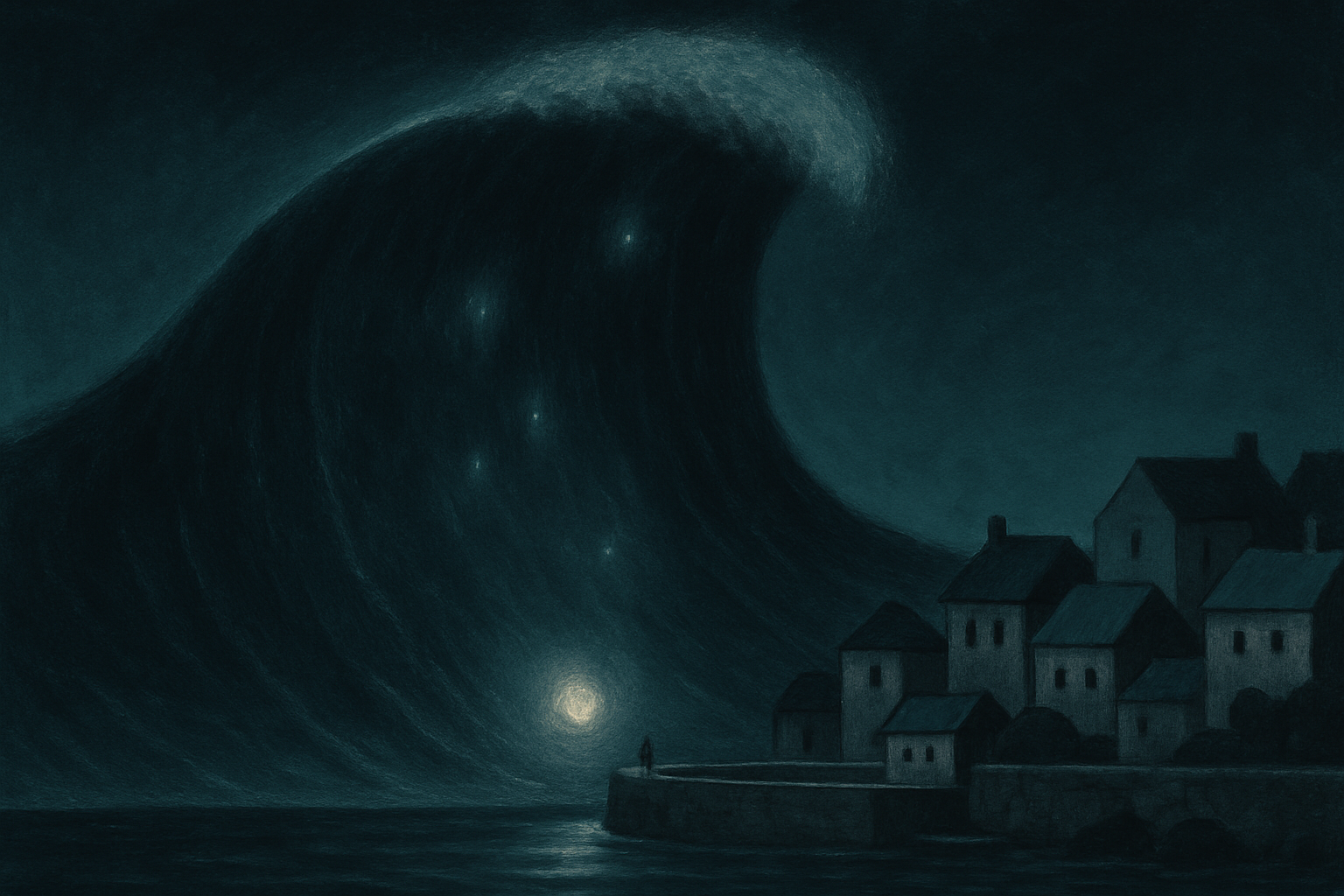
It did not come as a wave. It came as a wall, black and silent, rising from a windless sea until it blotted out the stars. Within it swam pale shapes, the drowned, their eyes lit by a light that belonged to no world above. Perseus stood on the seawall with the old sword unwrapped in his hands, and beside him stood Helius, refusing to run.
"You cannot fight the ocean," Helius said.
"No," Perseus agreed. "But I have never let that stop me."
The wall broke over Argos. The drowned poured through the streets, and where their hands touched living men, the men fell and did not rise. Perseus fought through them, cutting, shouting Helius's name, and then a hand of green water closed around his chest and dragged him down, down, past the light, into the deep.
He did not drown. That was the cruelty of it. Some blood of his father kept the water from his lungs, so he was awake for all of it, the descent through the drowned cities, the temples of black stone, the forests of pale weed that reached like fingers.
And at the bottom, on a throne of ship's timbers and whale bone, sat Nerion.
He was beautiful the way a knife is beautiful. He rose when he saw Perseus, and his smile was the smile of a boy who had waited a long, long time.
"Brother," Nerion said, and his voice carried through the water without air to carry it. "I have wanted to see your face. The favored one. The son they let live."
"I was not favored," Perseus said. "I was hunted, same as you."
"And yet you stand in the light and I do not." Nerion circled him. "Do you know what it is, to be given to the dark before you can even open your eyes? I learned to love it. Poseidon taught me the deep is honest. It takes everything and pretends nothing. Not like Olympus, with its gifts and its lies."
"Poseidon is dead," Perseus said. "The gods are dying. There is no throne to inherit."
"Good." Nerion's eyes flashed. "Then no one will stop me from building a new one. A world with no sky to look up to. A world that cannot forget the sea, because it will be the sea." He spread his arms. "Join me, brother. You have Zeus's blood. Together we would be the last gods. We would be worshipped by the drowned forever."
For a moment, only a moment, Perseus felt the pull of it. He was tired. He had buried a wife. He had fought the whole vault of heaven and been given, in return, a fishing net and a slow old age. Here was kin. Here was power. Here was an end to being alone among mortals who could never quite meet his eyes.
Then he thought of Helius on the seawall, refusing to run.
"No," Perseus said. "I have already been a god's weapon. I would rather be a man's father."
Nerion's face closed like a shell. "Then you are only a man. And men drown."
The deep itself became his weapon. The water crushed inward. The drowned swarmed. Perseus fought with a fury he thought he had left on the plains of the Kraken, but a man cannot out-fight an ocean, and slowly the cold hands bore him down.
It was Thetis who saved him, or rather what she gave him. Before the wall had broken, she had pressed something into his hand: a single tear of the sea goddess, frozen hard as a pearl. "When you have no more to give," she had said, "give this. It is the sea's own grief for all it has swallowed. Even the deep can be made to remember mercy."
Perseus, pinned to the black floor, opened his fist. The pearl dissolved.
And the drowned remembered.
They remembered warm hearths and the faces of children waiting. They remembered names. One by one they stopped, their pale eyes filling with something that was almost tears, though they were made of tears already. They turned from Perseus. They turned to Nerion.
"No," Nerion said. "You are mine. The deep took you. You belong to the deep."
"We were taken," one of them said, in a voice like tide over stones. "We were never given."
They rose against him, the whole drowned host, and Nerion's power broke upon them like surf upon rock. He reached for Perseus one last time, and Perseus caught his brother's hand, not to strike, but to hold.
"Come up," Perseus said. "There is still light. It is not too late to see it."
But Nerion had been in the dark too long. "I would be blinded," he whispered, and something in his cold face grieved for what he could not want. He let go. The deep folded over him, and its lord sank into his own kingdom, alone as he had always been.
The waters withdrew from Argos at dawn.
Helius found his father on the beach, half-drowned and wholly alive, the old sword lost forever to the sea. They sat together as the tide crept back to its proper line, gentle now, ordinary.
"Was he really your brother?" Helius asked.
"He was," Perseus said. He looked at the water a long while. "He asked me to be a god. I told him I would rather stay here."
Helius said nothing, but he moved a little closer on the cold sand, and that was answer enough. Above them the sky was empty of gods now, truly empty at last. And Perseus found, to his surprise, that he did not mind. The world belonged to the ones who lived in it. It always had. It had only taken the death of heaven for men to finally believe it.