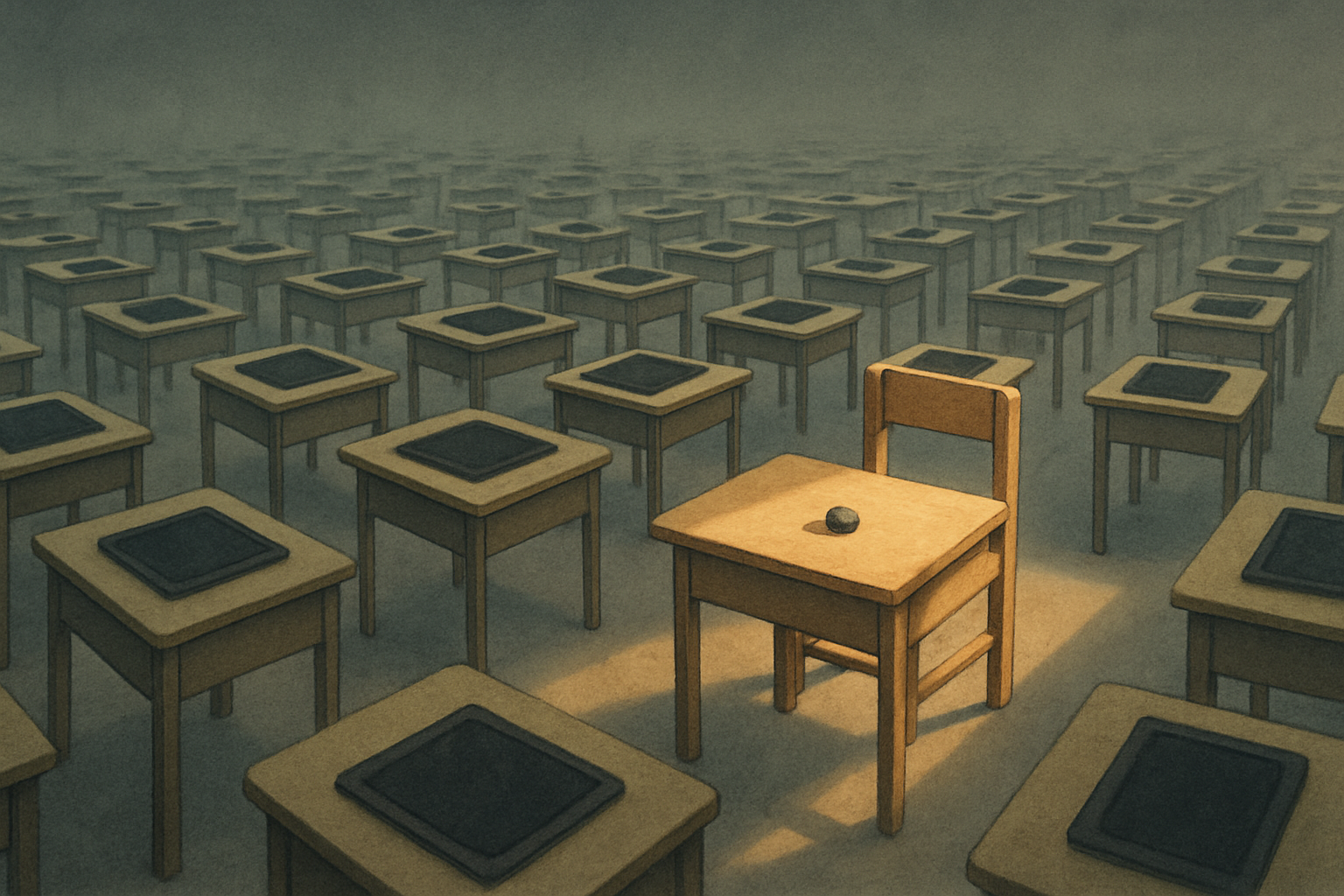
The hall had no windows, only the pale even light that the Board preferred, the kind that cast no shadows and let no one hide the tremor in their hands.
Elen sat at desk seventeen, as she had for six days, her stylus poised above the slate that had eaten every answer she had ever given it. Around her, three hundred candidates bent like reeds over their own slates. Somewhere a chair scraped. Somewhere a boy wept without sound, his shoulders climbing and falling.
They had all been told the same thing since childhood. The Test measured you truly. The Test could not be fooled. Whatever the Test decided, that was what you were, and the Republic arranged your life accordingly: the fields, the ministries, the labs, the quiet rooms where the failed were kept and, it was whispered, unmade.
Elen had been the best in her province. Her mother had wept the good kind of tears when the summons came. Now, on the seventh morning, only the final question remained, and the slate had gone dark except for a single line.
WHAT IS THE RIGHT ANSWER?
Elen read it four times. She waited for more. A prompt. A paragraph. A diagram of the sort she had dismantled all week. Nothing came. The cursor blinked with the patience of something that had asked this of a thousand generations.
She glanced left. The woman at desk sixteen was writing furiously, filling the slate with equations, her lips moving. To the right, an old man (they let the old sit the Test too, if they had never passed) had begun to sketch a proof so intricate it looked like frost on a pane.
Elen set her stylus down.
There was, she realized, no question here at all. Only the shape of one. WHAT IS THE RIGHT ANSWER. The right answer to what? To the Test? To the six days? To the life she was auditioning for?
A memory surfaced, unbidden. Her younger brother, Tam, who had failed his Test three years ago at the age of fourteen. Failed it spectacularly, they said, answered the ethics module by writing the same sentence forty times: I would not leave him. The examiners had marked it a defect of reasoning. Tam had been taken to the quiet rooms. Her mother did not speak his name anymore.
Elen had spent three years becoming the opposite of her brother. Precise. Correct. Unleaveable in no direction, attached to no answer, loyal only to the rubric. She had made herself into a machine that produced right answers, and here at the end the machine was being asked, gently, what a right answer even was.
She lifted the stylus and wrote: There is no right answer to a question with no subject.
The slate did not respond. The cursor blinked.
She crossed it out. She wrote instead: You are not testing my knowledge. You are testing whether I will invent a question so that I have something to be correct about.
The cursor blinked.
Elen's heart began to move strangely in her chest. She looked up. At the front of the hall, on the raised dais, a proctor stood in the grey robe of the Board, hands folded, face smooth as a spoon. Elen had never once, in six days, seen a proctor look at anyone. They watched the slates, which watched the candidates. The whole apparatus faced inward on itself, an eye examining an eye.
She stood up.
The scrape of her chair was enormous in that hall. A hundred heads did not turn, because to look up from your slate during the Test was itself a failure, and they had all learned that in their bones. But she felt the room stiffen, felt the held breath of three hundred people who had heard someone break the surface of the water.
The proctor's eyes rose to meet hers. There was, in them, something she had not expected. Not anger. Not the machinery of punishment warming up. Something closer to hope.
"Candidate seventeen," the proctor said. "You have not answered."
"I have," Elen said. Her voice shook and then steadied. "The answer is that I refuse the question."
A murmur, quickly swallowed. The old man at desk eighteen had stopped his frost proof and was staring at her with wet, astonished eyes.
"Explain," said the proctor.
"My brother failed this Test," Elen said, "because he would not abandon someone. You called that a defect. But I have sat here for six days abandoning everyone. I gave the answers that lose the fewest points. I chose the sacrifice that the rubric preferred. I let the drowning man drown because the module said the bridge served more. And every day I got better at it, and every day you gave me more." She was crying now, openly, the way Tam must have cried when they came for him. "You are not sorting us by how much we know. You are sorting us by how much we are willing to give up to be told we are right. And the ones who give up everything, you make into ministers. And the ones who won't, you take away."
The hall was utterly silent. Even the cursors, she imagined, had stilled.
The proctor came down from the dais. Up close she was younger than Elen had thought, with a scar along her jaw, and when she spoke it was almost too quiet to carry.
"Do you know how many candidates reach the last question?" the proctor asked.
"All of us. It's the seventh morning."
"Do you know how many stand up?"
Elen said nothing.
"In my nineteen years," the proctor said, "eleven." She let that sit. "The Test does not measure your worth, candidate. It never did. The Republic decided long ago that it did not want the correct. The correct are only obedient with extra steps. It wanted the incorruptible, the ones who, when offered a lifetime of being told they are right, will stand up and say the price is too high. Those eleven. They do not become ministers." A ghost of a smile. "They become us. They become the ones who write the questions and watch for the ones who refuse to answer them."
Elen thought of her brother, and her breath caught. "And the ones you take to the quiet rooms?"
The proctor's smile faded. "Some tests are older than their mercy," she said. "We have not been able to change everything. But we are changing it. One refusal at a time." She held out her hand, and in her palm was a small grey token, and stamped on it a single word Elen had never seen on any slate: ENOUGH. "Your brother wrote I would not leave him forty times. That is the best answer this examination has ever received. It was filed as failure by a machine that could not read it. We have been looking for his family for three years."
Elen's knees nearly gave. "Then he's"
"In the quiet rooms, which are not what the whispers say. They are where we keep the ones we could not reach in time, until we can. He is teaching the younger ones to draw." The proctor pressed the token into Elen's hand and closed her fingers over it. "Come. There is someone who has been waiting for you to stand up."
Behind them, at desk eighteen, the old man laid down his stylus. He had understood. Slowly, joints cracking, seventy years of getting the answer right dissolving off his shoulders, he rose to his feet too, and he began, at last, to smile.